
TL;DR
Moving your rig into a closet can drastically cut noise—if you manage placement, gaps, and airflow. Foam alone won’t soundproof; sealing gaps and strategic positioning matter more.
Ever tried to record in a tiny closet? It’s a mixed bag. On one hand, it’s a quick fix—close the door, add some foam, and you’re good. But on the other, unless you handle placement and sealing right, you’re just trading echo for muffled noise or heat buildup.
Here’s the truth: the most effective way to quiet your rig isn’t about more foam or panels. It’s about where you put the rig and how you manage airflow and gaps. This guide pulls back the curtain on turning a small closet into a quiet, workable space—whether for voice-over, music, or AI work—without breaking the bank.
Acoustic dampening
& the rig in the closet.
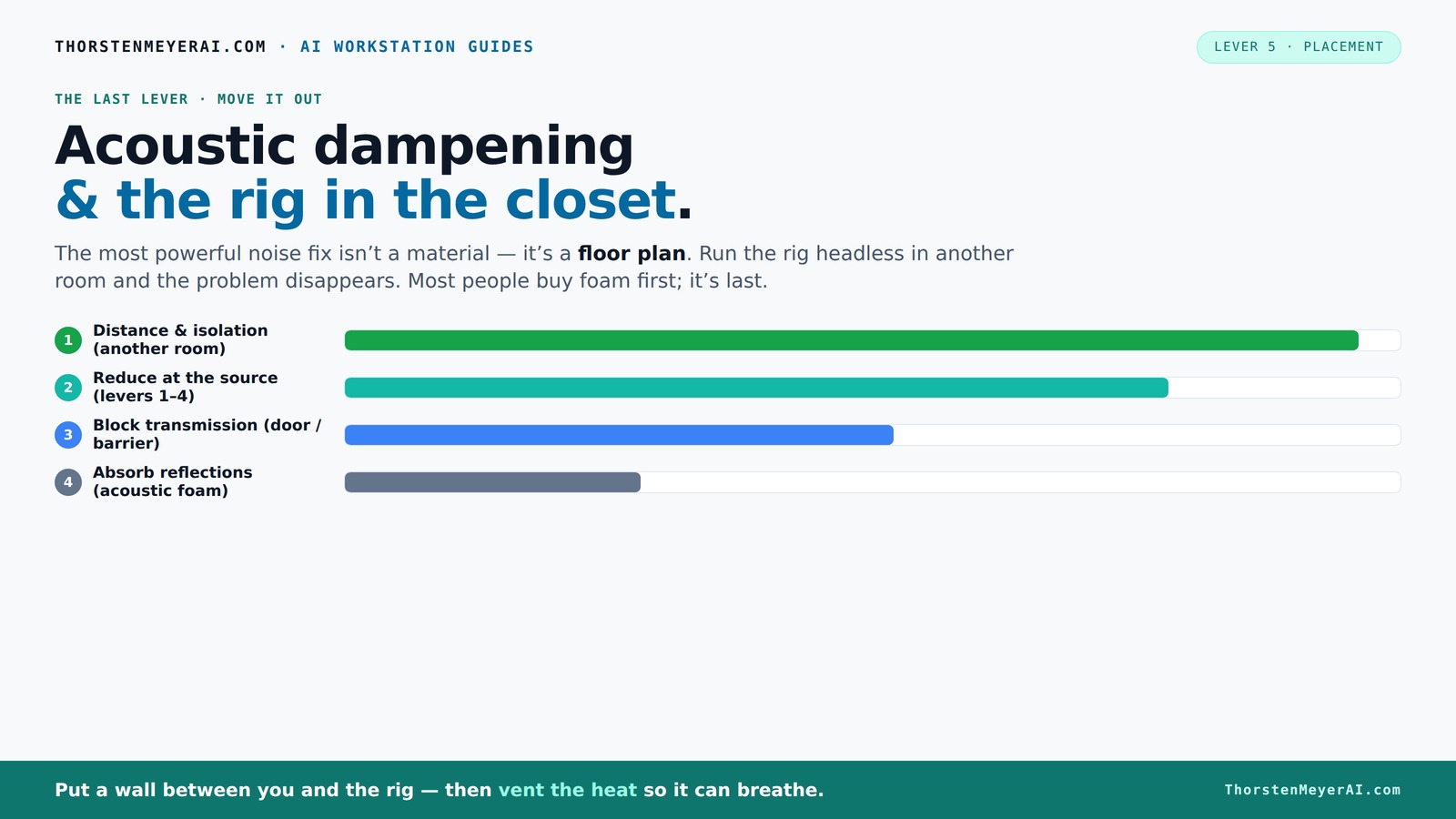
The most powerful noise fix isn’t a material — it’s a floor plan. A rig you can’t hear because it’s in another room beats any amount of foam. Tap the approaches in Part 1 to see what actually works.
(another room)
(levers 1–4)
(door / barrier)
(acoustic foam)
Contain the noise, not the heat
Key Takeaways
- Sealing gaps around the door, outlets, and edges is more effective than just adding foam.
- Moving your rig into another room or closet can eliminate noise issues completely, especially with a wired connection and proper ventilation.
- Placement of the mic, reflection points, and soft materials is critical to reducing echo in small spaces.
- Ventilation isn’t just for cooling; it prevents heat buildup that can cause fans to roar and throttle your rig.
- Bass traps in the corners can significantly improve sound quality in tiny closets by avoiding low-frequency buildup.

Focusound 52 Pack Acoustic Foam Panels 1" x 12" x 12" Sound Proof Foam Panles Soundproofing Noise Cancelling Wedge Panels for Home Office Recoding Studio with 300PCS Double-Side Adhesive
Soundproofing - Acoustic foam panels triangular grooves structure for better noise absorption, helps to reduce and absorb unwanted...
As an affiliate, we earn on qualifying purchases.
As an affiliate, we earn on qualifying purchases.
Why Your Closet Can Actually Be a Good Vocal Booth — If You Do It Right
Yes, a closet can become a surprisingly effective vocal booth, but only if you understand its limits. Small rooms amplify low frequencies and can create echo or bass buildup. The secret is in smart placement and proper dampening, not just slapping foam on the walls.
Think of a closet as a tiny chamber where sound can bounce around. When you place your mic properly—facing away from hard surfaces and isolating reflections—you minimize echo. Using soft materials like blankets, rugs, and foam at reflection points dampens harsh sounds. But the real win? Moving the rig into a space where noise can’t reach you.
For example, a YouTuber turned her walk-in closet into a recording space. She added blankets over the door, placed acoustic panels behind the mic, and used a door seal. The result? Clear vocals without a major remodel.
Understanding why this matters is key: small spaces tend to boost certain frequencies, especially bass, which can muddy recordings. Proper placement and dampening help control these problematic frequencies, leading to clearer sound. Additionally, managing how sound reflects within the space prevents echo and reverberation, making your recordings more professional. The tradeoff is that you need to strike a balance—over-dampening can make the space sound unnatural, while under-dampening leaves echoes. The goal is to find that sweet spot where sound is balanced and controlled without sacrificing clarity.

Audimute Soundproofing Acoustic Door Seal Kit - Door Sweep and Seal - (Large Size)
Includes (2) Door Seals (3/16" x 1/2" x 50') and (1) Door Sweep (1/2" x 1.5" x 25').
As an affiliate, we earn on qualifying purchases.
As an affiliate, we earn on qualifying purchases.
Best Mic and Panel Placement Tricks for Tiny Rooms
Placement is everything. The first step is to identify reflection points—usually where your mic faces and nearby surfaces. Use a mirror to find these spots: when you see a wall or a reflective surface in the mirror from the mic position, treat it.
Place your mic facing a soft, treated wall or reflection filter. Position acoustic panels directly behind the microphone or at the main reflection points to absorb sound bouncing back. Use blankets or foam to cover the door and the wall behind the chair.
Here's a quick checklist:
- Mic facing away from walls
- Reflection points covered with foam or blankets
- Soft materials on the door
- Floor covered with a rug
For example, a voice actor in a closet used a combination of foam panels and a thick blanket over the door, with the mic pointed at a foam-covered wall. She avoided placing the mic directly in front of reflective surfaces, cutting echo significantly.
Why this matters: Proper placement reduces the risk of capturing unwanted reflections and echoes, which can muddy your recordings. By strategically positioning your microphone and dampening reflection points, you optimize your sound quality without investing in excessive gear. The tradeoff here is that improper placement can lead to increased reverb or unwanted noise, so taking the time to set up correctly yields better results and more professional recordings.

HG Power 6 Inch Exhaust Fan: Kitchen Exhaust Fans with Power Cord Attic vent Fan with Damper Wall Small Fume Extractor Ventilation Fan for Shop Chicken Coop Basement Smoking Room Garage Silver
Powerful Ventilation Capacity: Equipped with a potent motor and large 7 blades, the fan efficiently eliminates smoke, humidity,...
As an affiliate, we earn on qualifying purchases.
As an affiliate, we earn on qualifying purchases.
Sealing Gaps and Managing Noise Leaks — Why It Matters More Than Foam
Gaps around the door, outlets, or wall edges leak sound like a sieve. Acoustic foam doesn’t seal these leaks—only sealing materials do. Sealing gaps and using weatherstripping, door sweeps, and acoustic sealant are your best friends here.
For example, a musician sealing her closet door with weatherstripping reduced sound leaks by over 50%. She also hung a thick blanket overlapping the door when closed, creating a barrier that kept outside noise out and sound inside.
In small rooms, even tiny cracks matter—so take your time sealing every gap. It’s the cheapest and most effective fix for sound leaks. The reason this matters deeply is that sound leaks can undermine all your dampening efforts, making even the best acoustic treatment ineffective. Gaps act like open windows, allowing noise to escape and outside noise to intrude, defeating your goal of a quiet space. The tradeoff is that sealing every crack takes patience and attention to detail, but it’s worth the effort for a significant reduction in noise pollution and improved sound quality inside your booth.

2 Pack Studio Monitor Isolation Pads for Speakers 3-5 Inches Sound Insulation Studio Foam Prevents Vibrations Acoustic Speaker Isolation Pad High Density Fits Most Stands
Enhanced Sound Clarity: Saiqiang speaker isolation pads can reduce vibrations and resonance, providing cleaner, more accurate sound from...
As an affiliate, we earn on qualifying purchases.
As an affiliate, we earn on qualifying purchases.
Ventilation and Heat Management — Keeping Your Closet Rig Cool and Quiet
Putting a hot, power-hungry rig in a closet isn’t just about noise; heat can turn it into a toaster. Without proper airflow, temperatures can spike, causing throttling and more noise from fans.
The key is to provide active ventilation—think vents, exhaust fans, or ducted airflow. A simple passive vent with a small fan can pull hot air out. For more on cooling and noise reduction strategies, see this guide for more on cooling and noise reduction strategies.
Why this matters: overheating can cause your PC or audio interface to throttle performance, leading to increased noise from fans and potential hardware issues. Proper ventilation ensures your equipment runs efficiently and quietly, avoiding heat-related disruptions. The tradeoff is that adding ventilation components can introduce sound if not carefully selected or installed, so choosing quiet fans and sealing duct connections properly is crucial. For more serious setups, consider purpose-built soundproof cabinets with temperature-controlled airflow. These blend quiet operation with effective heat dissipation, keeping your rig happy and silent.
Check out [this guide](https://thorstenmeyerai.com/reduce-heat-noise-ai-workstation/) for more on cooling and noise reduction strategies.
DIY vs. Professional: When Small Fixes Turn into Big Projects
Most DIY closet booths are simple and effective—blankets, furniture placement, sealing gaps, and strategic placement. But if you find low-frequency problems or heat issues persist, it might be time to consider more serious upgrades. For additional tips, visit minusred.com for workspace design ideas.
For example, adding bass traps in the upper corners can tame low-end resonance, especially in very small closets. If heat management becomes a challenge, a purpose-built soundproof cabinet with ducted airflow might be necessary.
Remember: DIY can get you 80% of the way there, but beyond that, professional solutions save time and avoid frustration. The tradeoff is that DIY solutions are more affordable and customizable but may not fully address complex issues like low-frequency resonances or heat dissipation, which require specialized equipment or construction. Investing in professional solutions can be more cost-effective in the long run if you're aiming for studio-quality results or dealing with persistent problems.
Check out [this article](https://thorstenmeyerai.com/low-noise-pc-cases-airflow/) for more on integrating cooling with soundproofing.
The Real Power of Moving It — Why Distance Is Your Best Friend
The loudest soundproofing trick? Just move the rig somewhere else. Distance kills noise—by the time sound travels a few feet, it drops significantly. An AI inference rig in a closet, accessed over the network, is often silent to your ears.
For example, a researcher keeps his noisy GPU in a closet on the other side of his house. He works comfortably at his desk with no noise, because the sound never reaches him. It’s the most effective, least expensive fix.
So, ask yourself: do you really need the rig next to you? Often, the answer is a quiet, networked machine in another room. The tradeoff here is convenience versus noise reduction. Moving your equipment away from your primary workspace reduces sound at the source, which often simplifies your entire noise management strategy. It also minimizes the need for extensive dampening and sealing, saving time and effort. The downside? Increased latency or setup complexity if remote access isn't seamless. But if noise is a primary concern, physical separation is one of the most straightforward and effective solutions.
Frequently Asked Questions
Can a closet really work as a vocal booth?
Absolutely. With proper placement, sealing, and dampening, a closet can be a surprisingly good space for recording vocals and voice-over work. It’s all about managing reflections and leaks.What is the difference between soundproofing and acoustic treatment?
Soundproofing stops sound from leaving or entering a space, usually by sealing gaps and adding mass. Acoustic treatment reduces echo and reflections inside a room, making it sound better but not necessarily quiet from outside noise.Where should I place acoustic panels in my closet booth?
Focus on reflection points—behind your mic and on the walls directly facing it. Covering the door and ceiling with blankets or panels also helps reduce echo and sound leaks.Do I need foam, blankets, or panels?
All can help, but blankets and soft materials are often more cost-effective for sealing and dampening. Foam panels are better for targeting specific reflection points but won’t stop sound leaks or low frequencies alone.How do I stop sound from leaking through the closet door?
Seal gaps with weatherstripping or acoustic seals. Hang blankets over the door or use a foam panel blanket. The goal is to create a barrier that prevents sound from escaping or entering.Conclusion
The real secret to a quiet, effective closet booth isn’t just foam or panels—it’s smart placement, sealing gaps, and managing heat. Moving the rig into another room often solves most problems at once. Think of your closet as a shell, not a prison, and treat it with the right tools and strategy.
Next time you set up a tiny studio, remember: distance, sealing, and ventilation are your best allies. Your ears—and your CPU—will thank you.